 |
||||
| ||||
Developing the open standards, tools and training that will drive the successful uptake of BIMBulletin 10, July 2013The Way ForwardBuildingSMART UKI provides input into bSI plansThe international arm of buildingSMART (bSI) is developing its business plan to ensure that its technical output meets the needs of organisations that are implementing open BIM. The Executive Committee (ExCom) met in London on 17–19 May 2013 to consider how the visionary document from bSI’s chair, Patrick MacLeamy – The Way Forward – could be realised in practice. Mark Bew, chair of bS UKI who also chairs the UK government BIM Task Group, attended the second day of the ExCom meetings. He was shown bSI’s list of priority projects which are seen as of direct assistance to the UK BIM programme. Collaboration between the UK government and buildingSMART in taking forward the work is seen as vital, and Mark’s input here is proving crucial. Projects are now being assigned to five categories: vendor-related projects; BIM-enabled co-working (such as an IFC4 primer); the product value chain; data drops (ie submitting data at key milestones of a construction project) which give value to the client; and infrastructure. ‘We are looking at all projects through a lens of the value proposition,’ said Francois Grobler, ExCom member and ITM chair. A busy six months lies ahead, as bSI completes the business plan and gets buy-in from strategic partners for the series of projects. ‘The business plan is the ultimate practical necessity for us,’ said Patrick.
Planning for the futureHighlights of July board meetingThe bS UKI Management Board held its quarterly meeting on 13 July at BRE in Watford. Mark Bew, chair of the bS UKI chapter who also leads the UK BIM Task Group, took the board through the driving forces behind the government Task Group: they fall into the areas of technical, commercial and cultural/market factors. It is in the area of technical input that buildingSMART (both UKI and International) has a role to play. One development highlighted at the meeting was the creation of an EU BIM Task Group, mirroring the UK Task Group but functioning at EU level. The UK has been asked to contribute.* The board also discussed the COBie trial (stage 2) project involving 14 contractors that is just getting off the ground. Product manufacturersBringing manufacturers’ products into the BIM environment has long been considered a priority. The task is formidably large, although much has already been done. But questions remain, for example, will project owners require manufacturers’ object models to be certified? Mark stated that government will not mandate certification but PAS 1192:2 can be certified against, as PAS 55 (Optimal management of physical assets) mentions ‘third-party compliance’. The discussion that followed suggested that the market would determine the demand for certification and PAS 55 certainly sets up a potential without actually requiring it. Experience on the BIM object templates to date indicates that standardising product manufacturers’ data is proving a problem, with the different requirements and constraints of the various parties, including the software vendors. Nick Nisbet, bS UKI technical co-ordinator, proposed an intensive project to bring together all the NBS Create property sets and create template data, and the bS UKI board agreed to formalise a proposal along these lines. Business planning at bSIRichard Petrie, bSI consultant, gave an overview of what lies immediately ahead for bSI and talked about the bSI business plan that is being developed (see the first story in this bulletin). The future – Digital Built BritainThe government initiative, Digital Built Britain, released its brand vision in the same week as the board meeting, and Mark took board members through its main features. It is a network that will help the UK realise its ambition to be a world leader in BIM, plugging in to other government initiatives such as Smart Cities and Smart Grids. This approach will provide the information to enable strategic investment decisions for networks and systems (like highways and energy) which cut across society. Digital Built Britain aims to find a way for the various BIM applications – in all their complexity – to work together and support the connectivity of data feeds from a network of sources. Big plans – and the Technology Strategy Board will be releasing a brief covering funding for projects at level 3 where there is still much to do and plenty of challenges, particularly in respect of collaborative working. But there will be life beyond level 3 of the maturity model, and by 2025, Mark said, industry and research should be looking at level 4. * The UK is working on two initiatives with the EU: first, the review of the EU Public Procurement Directive and the potential for considering BIM for public works, and secondly, the BIM Task Group is organising an EU BIM Conference in Brussels for October 2013.
The right resources for levels 2 and 3BuildingSMART UKI is working with buildingSMART International to develop the much-needed tools and resources that are needed for the UK government BIM programme. The programme aims to get public sector projects built using collaborative ways of working (level 2 of the maturity model) and ultimately in a truly integrated way (level 3). Mark Bew, head of the government BIM Task Group and chair of bS UKI, is working with international colleagues on the new bSI business plan (see above). He is providing input into the business plan which will tackle what the global and UK industries need immediately, next year and in the period up to 2016. This will allow priority projects to go to the head of the queue, as requirements are defined and sponsorship put in place. The collaboration was enhanced by the presence of bSI consultant Richard Petrie at the bS UKI board meeting on 9 July, where he took part in a discussion on the emerging business plan. Mark Bew commented: “It was a much better debate than I have had with the team for a long time.”
Technical Group meeting in May
The May meeting of the Technical Group (24/5) tackled knotty IFC issues and set up subgroups to take action. One area was certification, where the group identified a need for COBie certification carried out in the UK and a further need to for clear information on what products have been certified (and for what functions) under the bSI certification scheme. Improvements for greater openness are underway. The idea of an IFC challenge, whereby software vendors would show their prowess in interoperability, was raised. Suggestions were also put forward for the forthcoming BIM competition organised by the Technology Strategy Board, which had asked bS UKI to advise on the competition brief. And on home ground, the group supported the idea of a section on the bS UKI website that would allow members to share files and understanding of the interoperability problems that are often created – showcasing the good and the bad.
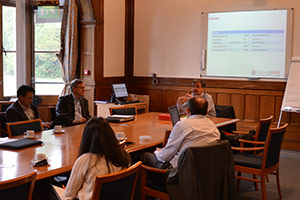
COBie againThe bS UKI/BRE regular training course on COBie took place once again on 27 June. Around 15 participants attended, with a good spread of disciplines, covering software developers, tier 2 specialist subcontractors, architects and contractors. Worksheets were used for some of the exercises, which were based on the space that the training took place in. Nick Nisbet, bS UKI technical co-ordinator, noted a greater sense of urgency about getting familiar with COBie, as more people encounter the demand for COBie, either from clients or from contractors determined to lead the curve. ‘There is a greater awareness of COBie: people are beginning to identify the tools and methods they will use to deliver not just the early stage design-oriented drops but also the later construction-oriented drops leading up to handover and “soft landings” [the government initiative],’ said Nick.
At a glance… dates for your diaryAll events are at BRE Watford, unless otherwise stated 5 September, 10:00am: iBIM workshop
Contact detailsbS UKI directorNick Tune (tunen@bre.co.uk) bS UKI managerZane Ulhaq (ulhaqz@bre.co.uk) Technical co-ordinatorNick Nisbet (nn@aec3.com) Bulletin editorBetzy Dinesen (betzy.dinesen@btinternet.com) |
|
|||
 |
||||
© Copyright BRE Group 2013 | ||||