 |
|||||
| |||||
Developing the open standards, tools and training that will drive the successful uptake of BIMBulletin 14, December 2013COBie trials: industry gives feedback
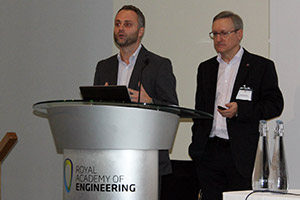
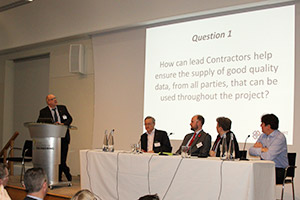
Phase 2 of the COBie field trials is nearing completion. A half-day event at the Royal Academy of Engineering in London on 12 November, chaired by Jeff Stephens of the buildingSMART User Group, heard the experience of industry participants and the preliminary findings. What started as a ‘proof of concept’ back in 2012 has blossomed into a hands-on trial using a live building project as a test case. The buildingSMART User Group worked with Gatwick Airport Ltd (GAL) who provided building designs for the Phase 2 tests. Client participationWith 227 buildings and 23,000 staff on-site, GAL is working to realise its long-term vision for the airport, known as Vision for 2020. At present, asset information does not meet all its operational needs, so it was keen to take part in a project that would tackle real-world problems head-on. The GAL building – small but complex – was split into eight discipline models, which were re-authored into six platforms, using software from different vendors. The contractors taking part had to federate the models and produce a COBie output using tools of their own choice. Industry feedbackFollowing a keynote address delivered by David Philp from the UK BIM Task Group, the trial project manager, David Jellings, summarised the importance and background of the trials. The path to COBie was not always smooth. This was the whole point of the trial: to throw light on the problems and produce recommendations. Representatives of participating contractors then offered their feedback. From VINCI Construction, Yazhe Li detailed several technical issues with various software. The aim was to highlight areas where more work is needed. Alan Lamping, Laing O’Rourke, explained the problems encountered and how they were fixed. David Throssell, Skanska, emphasised the need for an early definition of what the client wants from COBie and the ideal of a ‘reliable “one-click” IFC export’. Steve Lockley, of the University of Northumbria and the BIM Academy, then gave a taster of the COBie trial findings he aims to publish in December. A panel comprising David Philp, James Daniel from Willmott Dixon, Philippe Sauvageot from Mace and Jeff Stephens representing VINCI Construction considered the role of lead contractors and vendors and debated the future focus for BRE/buildingSMART trials. Find out moreThe final report on Phase 2 is being drafted and will be made available on the bS UKI website when published. The December issue of OPEN BIM Focus will report the trials in detail: keep up to date at http://www.buildingsmart.org.uk/openbim2. BuildingSMART – the global networkBuildingSMART UKI is not alone. It is one of more than a dozen chapters that go to make up the global buildingSMART family. The network allows international collaboration on technical and user work. In particular, it is the route for getting standards approved by ISO and carrying out certification of software. The individual chapters are members of buildingSMART International. They take part in international activities, lending their expertise and bringing back understanding of the latest developments to inform their work at home. Nick Tune, bS UKI’s business director, is treasurer for bSI and Nick Nisbet, bS UKI’s technical co-ordinator, is a member of the Model Support Group and International Technical Management Committee.
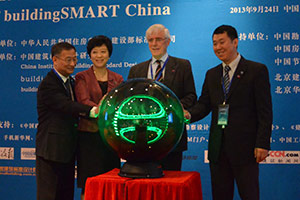
The Data Dictionary is a priority project for buildingSMART, and Nick Nisbet is once again involved. Hugh Woods of Atkins is a part of the Infrastructure Room activities while both Nick and Zane Ulhaq, bS UKI’s business manager, are taking part in the BIM guidelines project. ‘Our participation in international projects and groups means that the UK is involved at the leading edge of international standards for architecture, engineering and construction,’ said Nick Nisbet. The UK chapter is the third oldest and was formed in 1996. Two new chapters joined the family in 2013: Hong Kong and China (the latter based in Beijing). Further chapter development is underway – watch the bulletin for news on chapters in 2014. Chris Groome, bSI business manager who is also responsible for chapter development, was in Beijing for the foundation ceremony. He commented: ‘China has a sizeable construction industry, both at home and abroad. The creation of the China chapter, with its commitment to contribute to international standards, is a big step forward for bSI.’ Build Sydney Live
|
|
||||
 |
|||||
© Copyright BRE Group 2013 | |||||